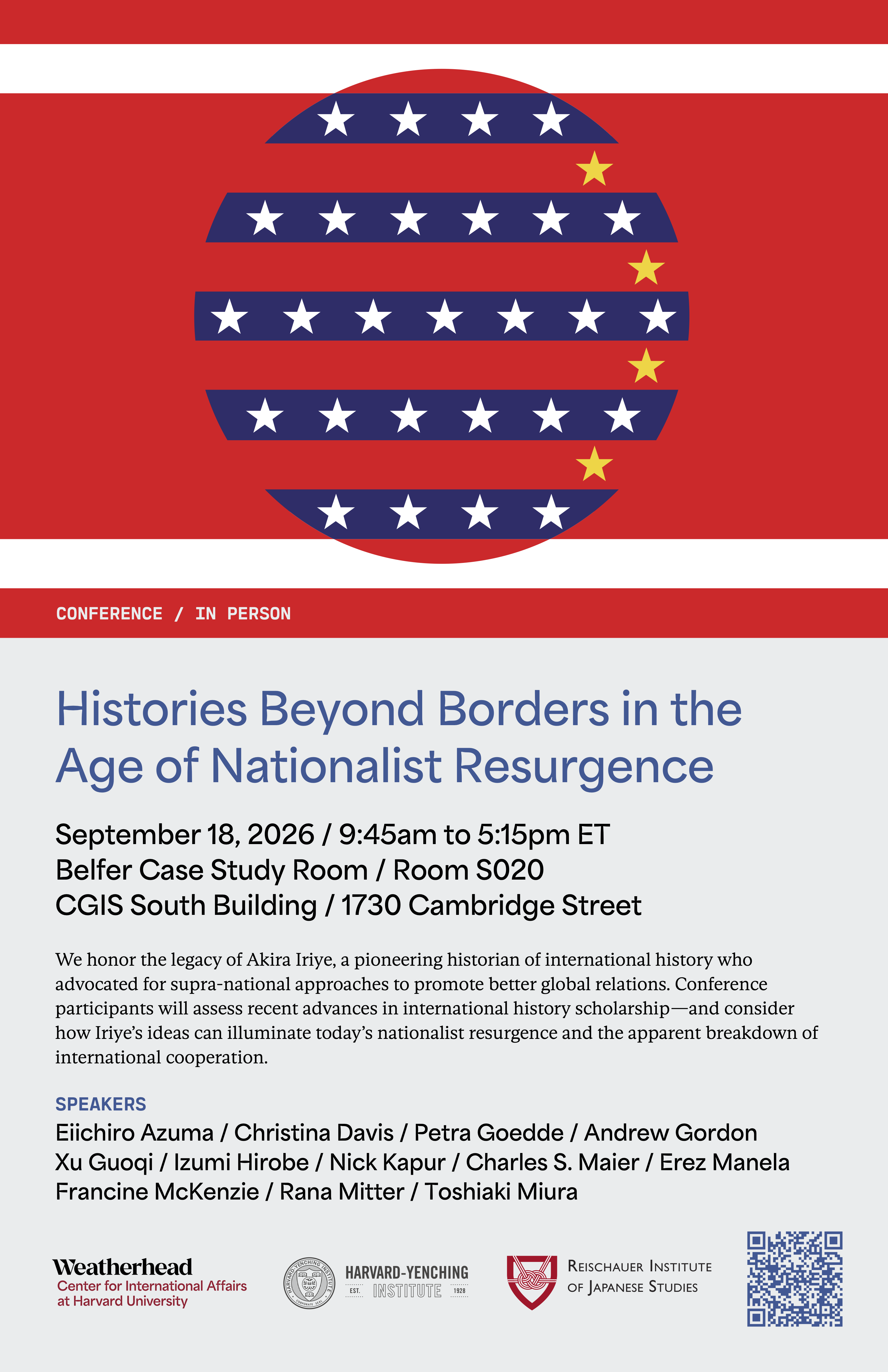
History Beyond Borders in the Age of Nationalist Resurgence: International Conference in Honor of Akira Iriye, Charles Warren Professor of American History
Please see conference website for registration and schedule.
This conference is open to the public. It will not be livestreamed, but will be recorded and may be posted online after the event. Registration is required to attend the conference.
Conference Description
The fields of international, global, and transnational history have been flourishing in recent decades. Akira Iriye, the longtime Charles Warren Professor of American History at Harvard who passed away in January of this year at ninety-one, was a pioneering figure in those fields, shaping their emergence and evolution. Iriye was also a lifelong cosmopolitan, whose lived experience in wartime and postwar Japan, and in the United States, left him with a conviction that supra-national approaches to history could help promote better relations among the world’s peoples.
In the context of nationalist resurgence in many places around the world, this one-day conference seeks to examine, through the lens of Iriye’s scholarly legacy, recent advances in the field of international history, broadly conceived. It asks what their future horizons and contributions might be and how they can help illuminate the current moment.
The three panels reflect three major areas to which Iriye contributed: two within the field of international history scholarship and the third related to the role of history and historians within the broader public discourse. These are the history of US-East Asian relations; the history of international organization (or what Iriye called “global community”) and the role of scholars in explaining the United States to broader publics in Asia.
Iriye’s groundbreaking scholarship on the international relations of East Asia was characterized by a pioneering focus on multi-archival, multi-lingual research and by its emphasis on the significance of culture and cultural relations in both diplomacy among states and connections among peoples. Panel I will assess recent developments in this field, asking how approaches such as Iriye’s can shed new light on contemporary challenges in the international relations of the region in the face of nationalist resurgence on both sides of the Pacific.
Iriye also played a pioneering role was the history of what he called “global community,” that is, the emergence and growth of international cooperation through international governmental and non-governmental organizations. Panel II will reflect on the state of the field, exploring how it can help us make sense of the apparent breakdown of international cooperation in recent years and where we might go from here both in scholarship and in practice.
Finally, Panel III will focus on Iriye’s prominent role as a public intellectual in Japan and Asia more broadly, reflecting first his influence on understandings of the United States in the region and, more generally, on the role that public intellectuals have played and could play in the future in promoting better relations between the United States, Japan, and China.
Organized by the Weatherhead Center for International Affairs with the Harvard Yenching Institute and Reischauer Institute of Japanese Studies