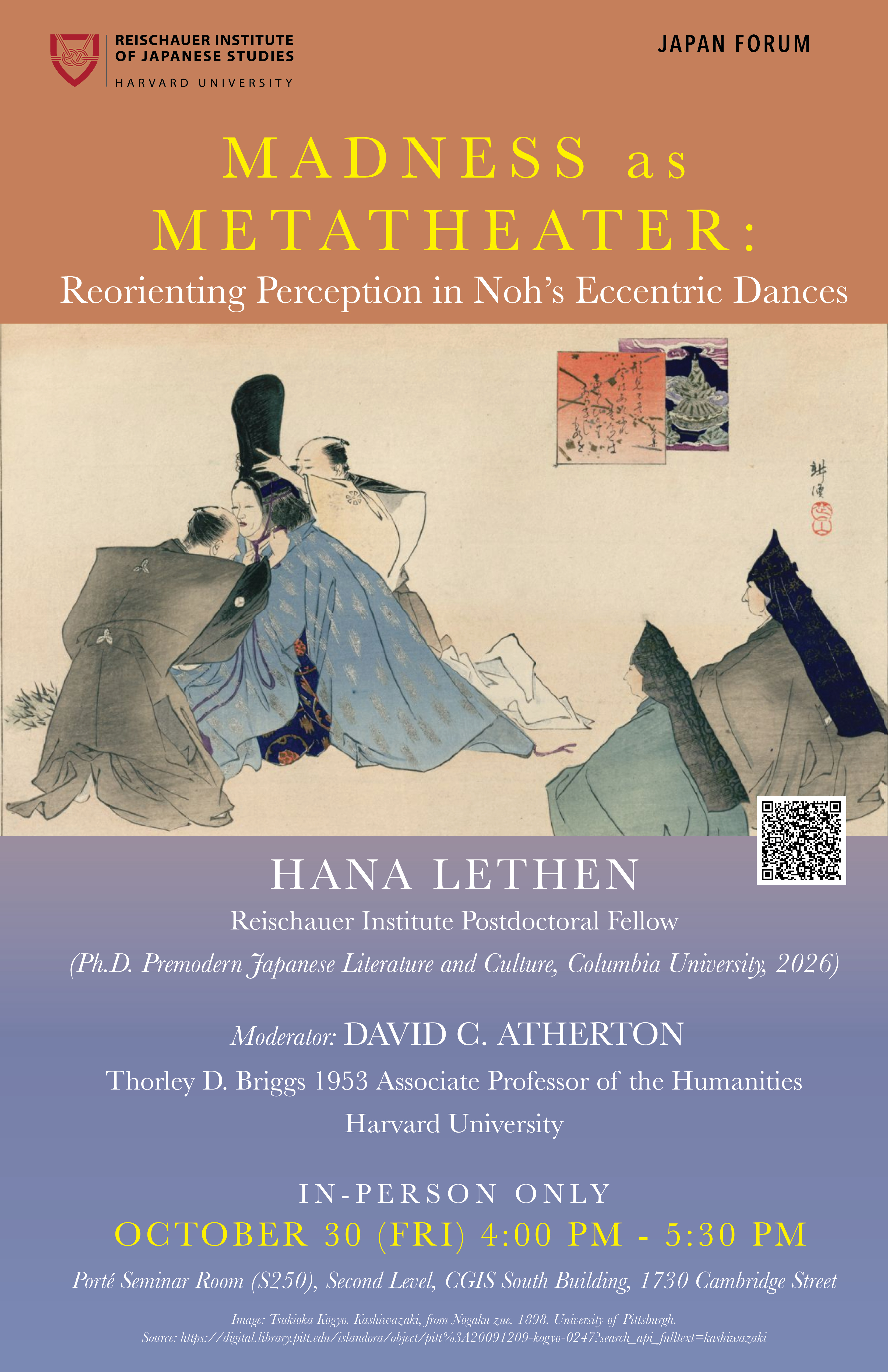
Madness as Metatheater: Reorienting Perception in Noh's Eccentric Dances
Why does the idiom of the “theatrical” tend to describe what is insincere or otherwise fictitious, when performance makes up so much of what we consider reality? To address this question, I turn to the dynamic world of fifteenth-century noh theater to illuminate alternative modes of engagement with the stage that take seriously its potential for reconfiguring perception. In particular, I investigate plays about madness (kurui), focusing on how such works employ metatheater, which I broadly use to refer to any element of the theatrical apparatus that draws attention to theater as theater. Noh’s metatheatrical stagings of madness are epitomized in the convention of “mad dances” of characters who are aware of their role as mad figures. Scenes like these make legible theater’s fundamental doubleness, where the performer simultaneously embodies self and other.
Through such dramatic innovations, medieval noh, I argue, cultivated an image of madness as performance in ways that reveal how medieval modes of spectatorship presumed plays to belong equally to the worlds of stage and audience. These worlds converge in noh’s mad dances, which trouble imagined boundaries between “performed” and “authentic” madness and highlight madness as an inherently theatrical phenomenon of the mind-body complex rather than an isolated or hidden intellect. Moreover, in an era where mundane reality was itself deemed illusory, madness and its performance exemplified the allure of medieval theater as a space for the enjoyment of the very craft of generating illusions. Noh’s stagings of madness thus disclose broader epistemic frameworks that shaped how medieval actors and audiences perceived and participated in the theatrical experience.
Reischauer Institute Japan Forum